What are options and how do they work?
When buying an option, you buy the right to buy or sell a certain amount of securities in the future for a certain price. For example, you make the agreement to have the right to purchase 100 specific shares for 6 months at a predetermined price. Options are a type of derivative. This means that the product derives its value from the price of the underlying asset. The underlying asset can be an index, a share or even a commodity. For example, you have index options, such as AEX options, or stock options, such as ING options. The value of an option is mainly based on the price of this underlying value, the mobility of the underlying value and the term of the contract. There are two types of options contracts, call options and put options. In this article, we will explain the difference between the two and answer some common questions about options.
What is a call option?
Buying a call option (long position) gives the right, but not the obligation, to buy an underlying asset at a predetermined price. The buyer pays a price for this right, also known as the premium. In addition to the price, the day on which the option will expire is also predetermined. This is called the expiration date. This indicates until when the buyer of the call option has the right to buy. As a rule of thumb, it is advantageous for a buyer to purchase an option if he or she predicts that the price will rise during the term of the contract. Investors use this strategy when they foresee certain movements in the market. On the other hand, the seller of a call (short position) has sold the right to buy, and therefore, may be forced to sell the underlying under terms of the contract if the buyer exercises the option. Buyers of and sellers of calls have opposing expectations of what is going to happen in the market. Sellers predict that the underlying asset’s price will be lower than the strike price and premium upon the option’s expiration. Sellers of options contracts are also called writers, which is discussed further in this article.
What is a put option?
Buying a put option (long position) gives the right, but not the obligation, to sell certain underlying assets at a predetermined price until the expiration date. The seller of a put option (short position) has sold the right to sell to the buyer and therefore may be forced to buy the underlying asset under the terms of the contract. Similar to calls, buyers and sellers have opposing expectations of how the value of the option’s price will play out. For the buyer of a put, it is usually advantageous if he or she predicts that the price will fall during the term of the contract. The seller of a put believes that the underlying asset’s price will be higher than the option’s strike price minus the option’s premium upon expiration.
What is the strike price of an option?
The price at which the underlying asset can be bought or sold is called the strike price. It is also known as the exercise price. The price of an option is influenced by various factors including the price of the share, the mobility of the share and the duration of the contract. If the underlying asset of the option is a stock, then the price difference between the stock price and the strike price determines the option’s value.
What is the leverage of an option?
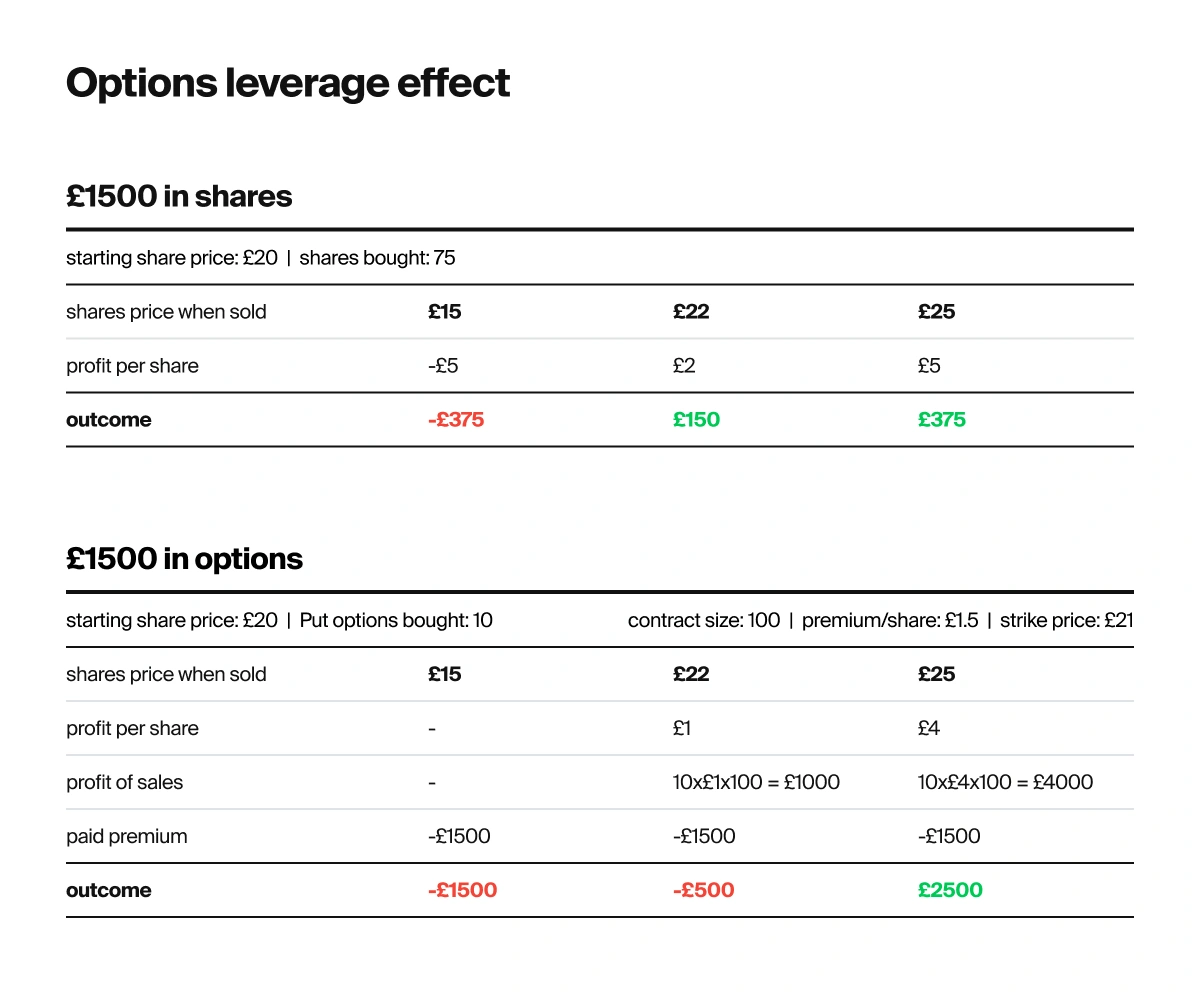
Options use the effect of leverage, as shown in the example below. Thanks to this effect, the profit that you can make with an option is greater than if you invested directly in the underlying value (calculated as a percentage). This is because you have to invest a smaller amount with an option than with a direct investment in the underlying asset. However, with an unforeseen movement of the underlying asset, you may lose money quickly and often.
What is the expiration date of an option?
As stated earlier, the expiration date is the day on which the option expires. Other derivatives, such as futures, also have an expiration date. In general, the expiry date falls on the third Friday of every month. However, there are exceptions, for example, with a day option or a week option. Before the contract expires, option holders can choose to exercise, close the position or let it expire worthless.
What does it mean to write an option?
Selling an option can be called "writing options". Two parties are involved in option transactions: a buyer and a writer. As mentioned, with a call option, the buyer gets the right to buy a certain option. The seller (writer), on the other hand, may be obliged to sell his or her shares at the predetermined price. The buyer pays an option premium, while the seller (writer) receives an option premium. The buyer hopes that the underlying asset goes up and the seller hopes that it goes down.
| Buy | Sell | |
|---|---|---|
| Call | Right to buy | Obligation to sell |
| Put | Right to sell | Obligation to buy |
What determines the price of an option?
The price of an option consists of two parts: the intrinsic value and the time value.
The intrinsic value
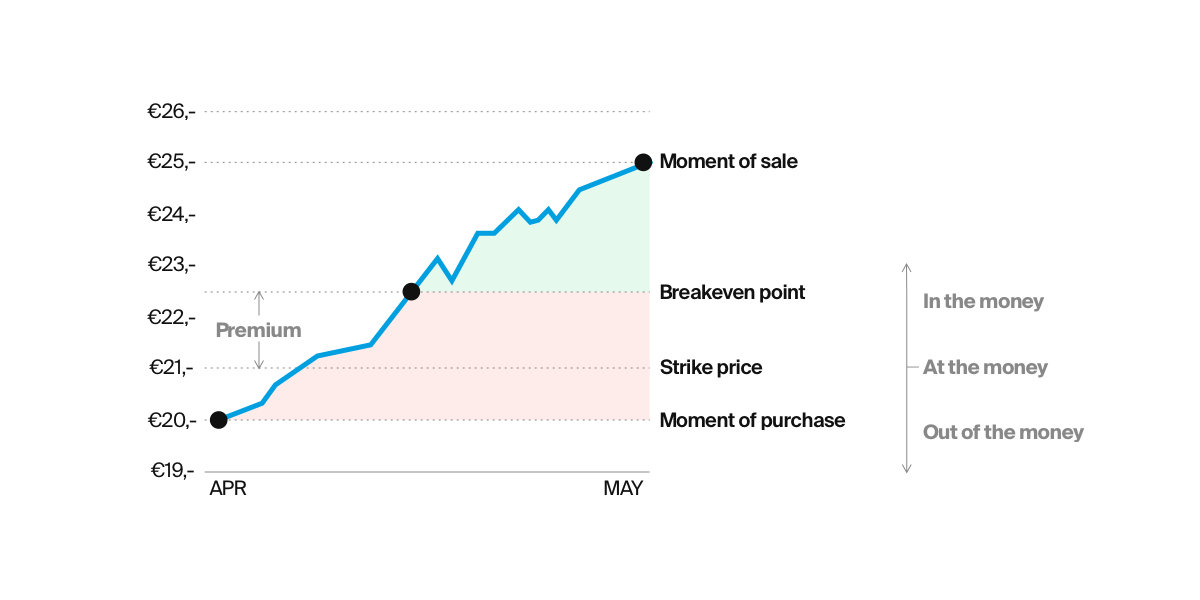
To calculate the net asset value, the current price of the share is compared with the exercise price. Continuing with the aforementioned example, the strike price is €21.00 per share. Suppose a share is listed on the stock exchange at €25.00. Then, the net asset value is the difference between the current price of €25.00 and the strike price of €21.00 per share, in this case, €4.00 per share. This right to buy at €21.00 is, therefore, worth at least €4.00 per share.
When an option has an intrinsic value, that option is called "in the money". This is possible for both call options and put options. For example, call options are in the money when the exercise price is lower than the price of the underlying asset. A put option is in the money when the exercise price is higher than the underlying value. If the opposite is true, the option is "out of the money".
The time value
The time value is also called the expected value. This mainly depends on the term of the option and the volatility of the underlying value. The time value indicates what the market expects from the price of the underlying asset. The remaining time until the expiration date (the expiry date) is taken into account in the time value. At the time of expiration, the time value and expectation value are almost zero.
What is the difference between American and European options?
The vast majority of options are either American or European style. The key difference between the two is in regards to expiry. With American options, the holder has the right to exercise it anytime before expiration at the agreed-upon price. Conversely, European options can only be exercised at the pre-agreed upon date and price.
Why use options?
There are many reasons why investors may choose to invest in options, but two of the main ones are for speculation and for hedging. Speculation is where an investor takes a position in a market and expects the price of an asset to increase or decrease. An investor, for example, may choose to speculate with a call option instead of buying the underlying stock outright because of the leverage with options, as discussed earlier. Investors may choose to use hedging strategies to reduce the risk of sudden price drops. For example, if an investor holds a sizable position in a company and wants to reduce the risk of a drastic price drop, they could buy a put option. By doing this, the investor can “lock in” a certain sell price. Moreover, if the stock’s price drops below the options strike price, the investor can exercise their put option, minimising losses.
What are the risks of options?
Investing in options can be beneficial, but it is not without risk. For example, specific rights and obligations are involved when entering these contracts. This means you run the risk of losing your entire investment or more. If the price of a share is lower than the strike price of a call on the expiry date, then it loses its value. When writing a call, you normally lose money when the rate rises. You then have the obligation to deliver the share at the exercise price. With a written put option, the risk is a fall in the price. You may then be required to purchase the underlying asset at the strike price. Is this price higher than the stock price? Then, you make a loss with the put option.
Before you invest in options, it is important that you first learn what the options are, but more importantly, that you understand the risks. Like other complex products, options are not suitable for beginning investors.
Read about other derivatives, such as futures.
The information in this article is not written for advisory purposes, nor does it intend to recommend any investments. Investing involves risks. You can lose (a part of) your deposit. We advise you to only invest in financial products that match your knowledge and experience.