What is an exchange traded fund (ETF)?
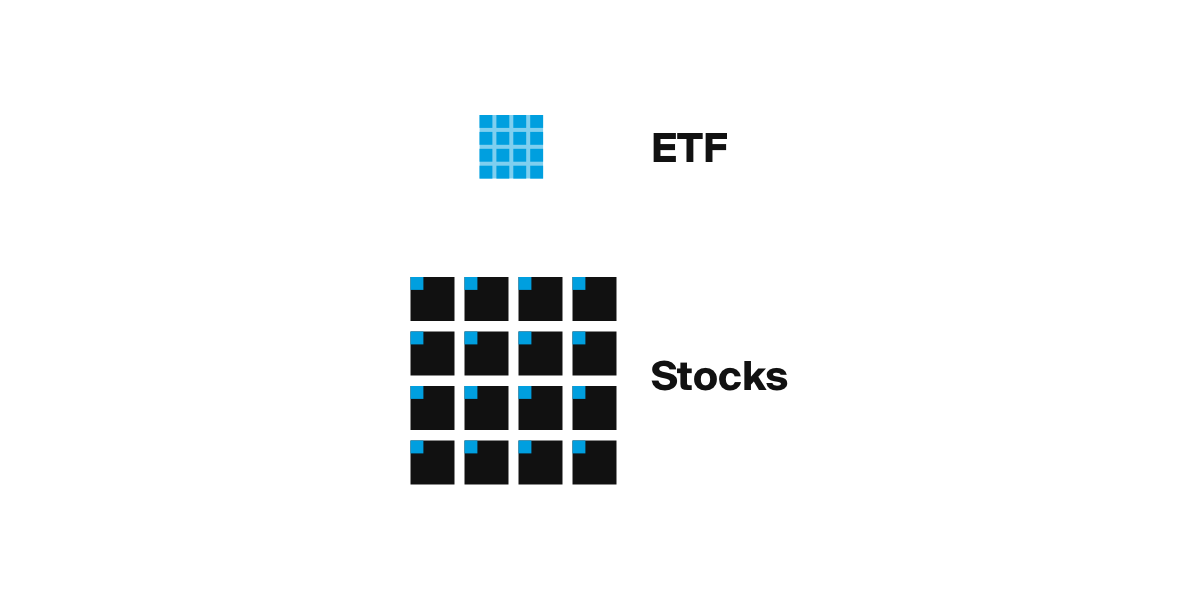
An ETF, also known as a tracker, stands for Exchange Traded Fund. It is a product that follows an index, commodity, bond or composition of products. You can think of it as a basket of securities. Unlike some other funds, ETFs are bought and sold on a stock exchange. The performance of an ETF follows the price movements of the underlying products in the fund. For example, an ETF that tracks the S&P 500 will be composed of fractions of shares of companies within this index. Since there are many underlying assets within one single product, ETFs enable you to easily diversify your portfolio at an affordable price.
The underlying assets of an ETF may differ. For example, this could be a selection of shares within a certain sector, a selection of bonds or even the value of a commodity. As a consequence, the differentiation level among ETFs may differ as well.
How does an ETF work?
When you buy a share, you become part-owner of the company. On the other hand, when you buy an ETF, you purchase a product that follows the performance of the underlying assets. In order to minimise the deviation of the performance of the ETF, a portfolio with comparable positions must be built up. The most important function of the investment manager is to check the weighting of the products in the ETF. He or she also monitors changes that have consequences for the ETF portfolio.
Types of ETFs
There are different types of ETFs, which can be used for different investment strategies. Below are some examples of more popular types of ETFs:
- Index ETFs are common and seek to replicate and track an index, like the S&P 500.
- Bond ETFs exclusively invest in bonds. The bonds invested in can be government, corporate and municipal.
- Commodity ETFs are designed to track the performance of commodities, such as gold or crude oil.
- Industry ETFs follow an industry as a whole, for example, technology, oil or pharmaceuticals.
- Inverse ETFs are designed to profit from stock declines by shorting stocks.
Non-leveraged versus leveraged ETFs
In addition to the aforementioned, ETFs can also be leveraged or non-leveraged. Unlike regular ETFs where the value of the ETF is comparable to the value of the underlying assets, it is also possible to purchase leveraged ETFs. If an ETF has leverage, it means that you borrow money from the issuing party to invest more in the underlying products than the amount you invest. These leveraged ETFs can be relatively complicated and focus on short-term results. They can have very high risks and costs involved and are, therefore, less suitable for the beginning investor.
What is the difference between an ETF and an investment fund?
An ETF can be compared to an investment fund, as with both types of funds people buy a composition of products or underlying assets. A big difference between an ETF and an investment fund is the management. An investment fund is managed by a fund manager who analyses the underlying products and typically actively seeks to achieve above-average results. Buying and selling, therefore, take place more often within an investment fund. The ETF manager only tries to track the value of the underlying products. Because of this difference, the costs of an investment fund are often higher.
Advantages of ETFs
ETFs can be profitable for investors due to their many advantages. Some of the main advantages are their trading flexibility, broad market exposure and relatively low costs.
- Flexibility: As mentioned, ETFs trade like stocks, which make them more flexible to trade compared to traditional investment funds. They can be traded at any time during the trading day and you can place different orders, such as market, limit, stop loss and stop limit. You can also buy them on margin or short sell them.
- Broad market exposure: Since ETFs are composed of a collection of products, they are able to achieve broad market access. Therefore, ETFs help with risk management through diversification.
- Low costs: ETFs are typically passively managed. Due to this, they have lower costs compared to actively managed funds.
Disadvantages of ETFs
Although ETFs have many upsides, like any other financial product, there are downsides too.
- Terms of liquidity: Like stocks, liquidity varies among different ETFs. If an ETF you are interested in is not very liquid, then it is not traded often and you may run into difficulties closing your position at a desired time and price. Oftentimes, the spread between the bid and ask prices are an indication of the liquidity. In general, if there is a large spread, it could be a sign that the ETF is illiquid.
- Expense ratio: These are the yearly operating expenses and are different from the trading fee, yet have a similar effect. The higher the expense ratio, the lower the returns.
- Similar products: ETFs seem very similar to Exchange Traded Notes (ETNs) and leveraged ETFs. They are however different and they also hold different risks. Because of the similarities, they are often confused with each other. Read this article to find out what ETNs are or this article to read more about leveraged ETFs.
How to invest in ETFs?
To invest in ETFs, you need a broker to place an order.
What are the costs of investing in ETFs?
In exchange for the maintenance of the product, the publisher charges a management fee. This is usually integrated in the price of the ETF. The management costs are typically lower than investment funds and are usually between 0.05% and 1%. You can find this price and more information about the product in the prospectus or Key Investor Information Document (KIID) prior to purchase.
Apart from the integrated administrator fee, you may also pay transaction costs to your broker when you buy or sell ETFs. These costs can be found on the website of the broker you invest with.
What is the risk of investing in ETFs?
Investing in ETFs can be beneficial, but it is not without risk. At EXDEGIRO, we are open and transparent about the risks associated with investing. Typically, ETFs are not actively managed. The risk is that it is not possible to anticipate changes such as company takeovers or a change in the index composition. Even though ETFs consist of a collection of products, so that element is diversified, also timing your investment can have a substantial impact on your returns. Rather than investing a single lump sum at once, thereby exposing yourself to the cost of your securities at a single point in time, you can instead opt to invest gradually over a longer period. By investing in smaller amounts, say on a monthly or quarterly basis, you will be less exposed to the price paid at the time of investment but rather the investment will be averaged out across a longer time frame. This method is known as unit cost averaging. Read more about diversification in this article. Before you start investing, there are a number of factors important to consider. It helps to determine how much risk you are willing to take and which products are best for you. In addition, it is not advisable to invest money that you may need in the short term or to take positions that may cause financial difficulties.
The information in this article is not written for advisory purposes, nor does it intend to recommend any investments. Investing involves risks. You can lose (a part of) your deposit. We advise you to only invest in financial products that match your knowledge and experience.